What is mitragynine, exactly?
Mitragynine is the dominant alkaloid of the kratom leaf: typically 60 to 70 percent of its total alkaloid content, first isolated in 1907, and the headline number on every credible kratom lab report. This page covers the chemistry, the natural ranges, and how it is measured and labeled, nothing more.
Mitragynine in plain terms.
The dominant alkaloid
Mitragynine typically makes up 60 to 70 percent of the total alkaloid content in kratom leaf, which is why it is the headline number on every kratom lab report.
An indole alkaloid
Chemically, mitragynine is an indole alkaloid, the compound family kratom shares with its Rubiaceae relatives such as coffee and cinchona. It was first isolated from kratom leaf in 1907.
Grown, not standardized
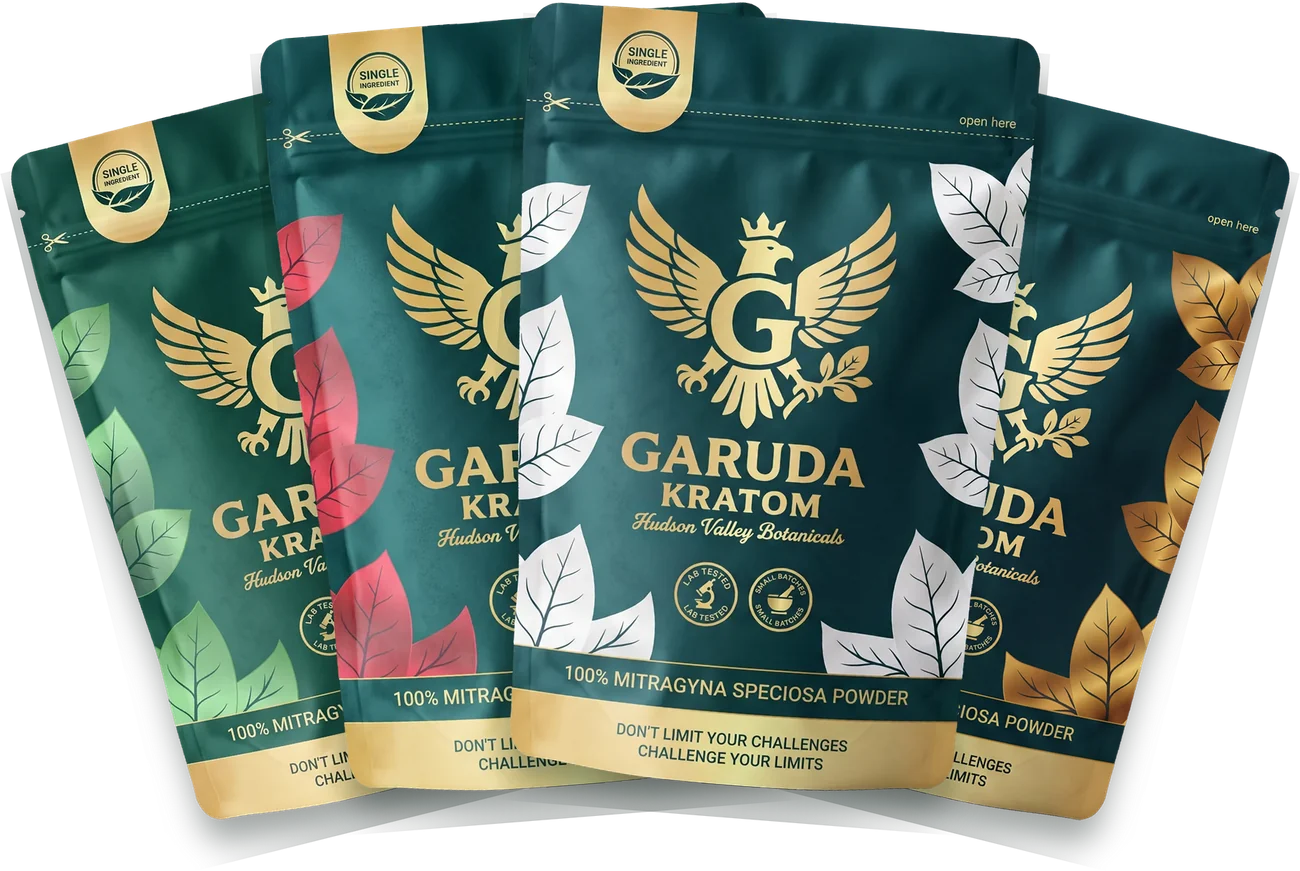
Mitragynine content is a property of the harvest: it varies by region, season, leaf maturity, and drying method. Across Garuda batches, red vein lots typically test in the 0.7 to 1.1 percent range and whites, greens, and golds higher, up to about 1.9 percent for gold lots.
Measured per batch
Because it varies, credible vendors measure it per batch. An independent ISO 17025 accredited lab quantifies mitragynine as a percentage of the sample, and the figure is printed on the certificate of analysis and, in our case, on the pouch label.
A labeling requirement
State Kratom Consumer Protection Acts commonly require alkaloid content disclosure on the label. Garuda pouches carry the batch's alkaloid percentage as standard, in every state.
Not the same as 7-OH
Mitragynine is distinct from 7-hydroxymitragynine (7-OH), a trace oxidative product of mitragynine present at well under 2 percent of leaf alkaloids. Concentrated semi-synthetic 7-OH products are a separate, separately regulated category that we have never sold.
What do Garuda batches actually test at?
| Vein | Typical mitragynine* |
|---|---|
| Red | 0.7% to 1.1% |
| White | 1.2% to 1.6% |
| Green | 1.3% to 1.7% |
| Yellow | 1.3% to 1.7% |
| Gold | 1.4% to 1.9% |
*Typical lab results across Garuda batches; every pouch ships with a batch-specific COA and results vary by harvest, region, and season. Red vein lots testing lower than whites, greens, and golds is the leaf, not a defect.
Common questions, answered straight.
What is mitragynine?
Mitragynine is the most abundant alkaloid in kratom leaf (Mitragyna speciosa), typically 60 to 70 percent of the leaf's total alkaloid content. It is an indole alkaloid, first isolated in 1907, and it is the primary compound kratom lab reports quantify.
How much mitragynine is in kratom?
It varies by harvest, region, and vein color, which is why per-batch testing matters. Across Garuda batches, red vein lots typically test between 0.7 and 1.1 percent mitragynine by weight, whites 1.2 to 1.6 percent, greens 1.3 to 1.7 percent, and gold lots 1.4 to 1.9 percent. The exact figure for any pouch is on its batch certificate of analysis.
How is mitragynine measured?
An independent laboratory quantifies it as a percentage of the sample as part of the alkaloid panel on a certificate of analysis. We use an ISO 17025 accredited lab for every batch and publish every report in a public archive searchable by the batch number on the pouch.
Is mitragynine legal?
The natural leaf and its mitragynine are legal in most US states; a handful schedule mitragynine by name, and those are the states where kratom is prohibited. Our state-by-state legality reference tracks the current status of all 50 states and DC with review dates.
This page is chemistry, botany, and labeling information, not medical advice. Kratom products are not intended to diagnose, treat, cure, or prevent any disease. These statements have not been evaluated by the FDA.