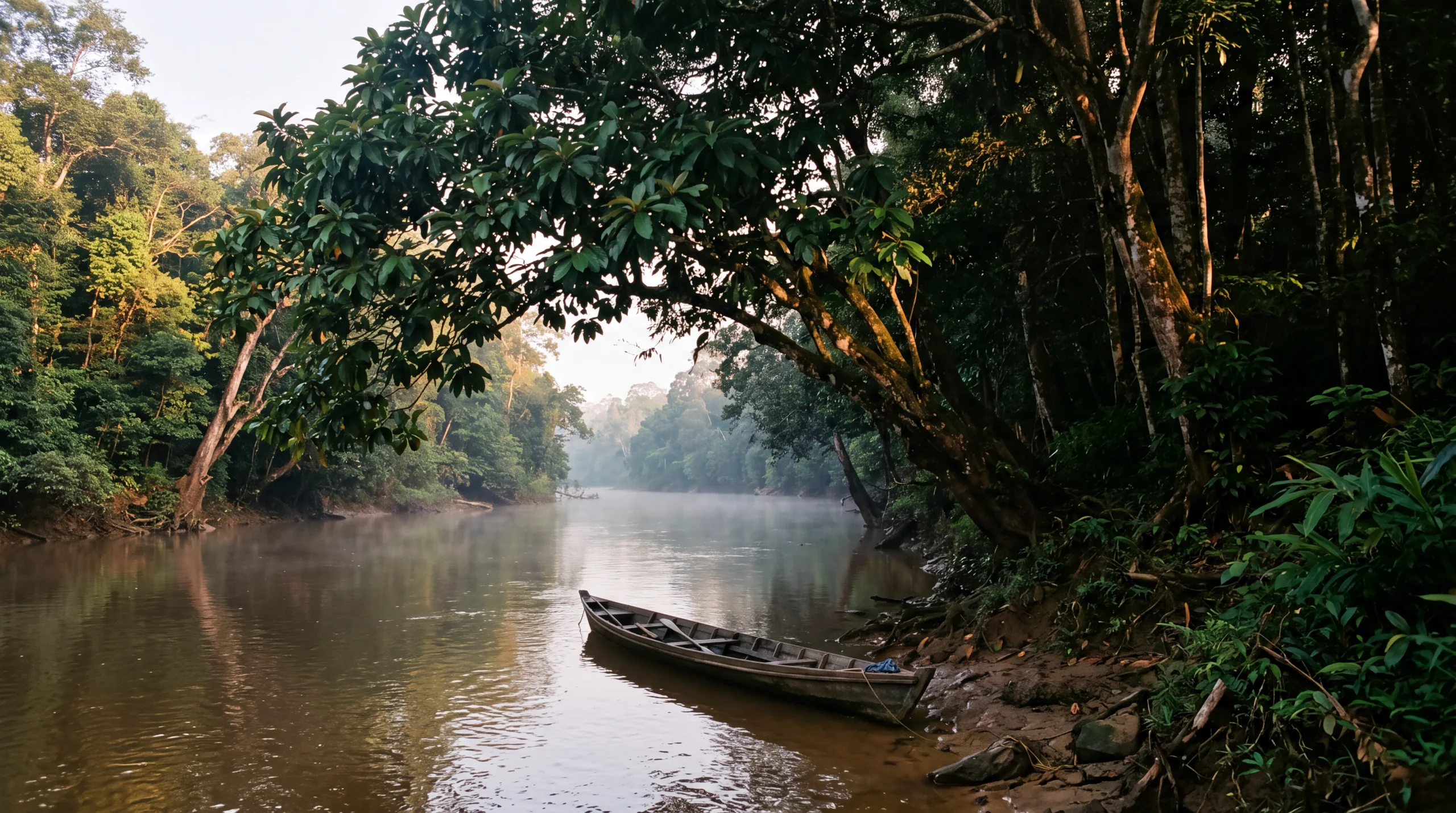
jungle river with canoe
Origin Story

The history of kratom in Southeast Asia.

Mitragyna speciosa entered the botanical record in 1839, and almost everything that happened to it since has been a matter of agriculture and law: which countries let it grow, which routes moved it, and which names the trade attached to it along the way. This page is that history. It is botany, cultivation, trade, and regulation only.

The Short Version

A Thai word for an Indonesian crop.

Kratom is a Thai word. The tree it names grows wild across a band of equatorial Southeast Asia, but the commercial leaf that reaches the United States today is almost entirely Indonesian, grown on family farms along the rivers of West Kalimantan and Sumatra. That gap between the name and the map is not an accident. It is the direct result of a 1943 Thai statute, and it explains most of what is confusing about kratom strain names.

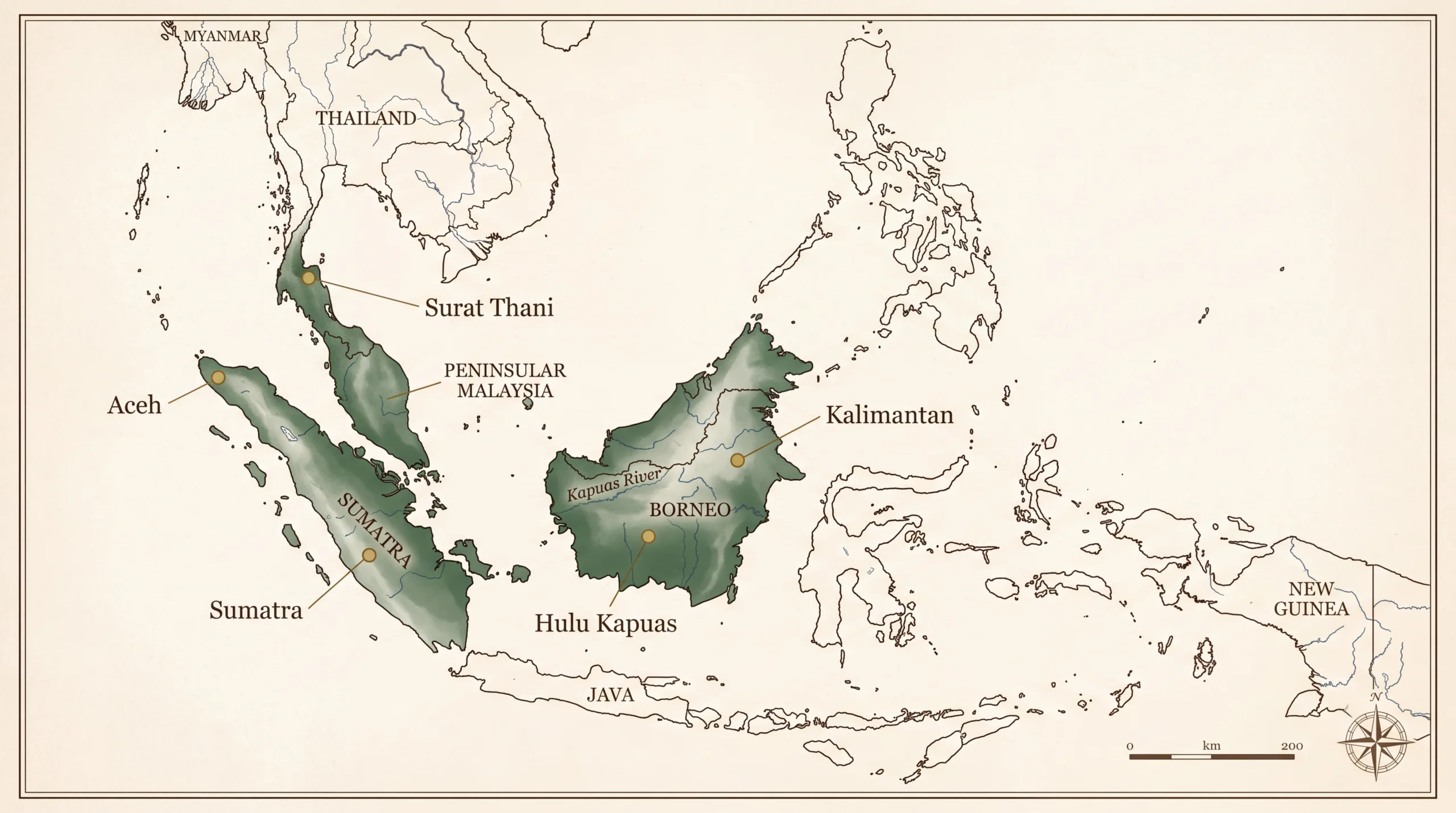
Map of Southeast Asia marking kratom growing regions: Surat Thani in southern Thailand, Peninsular Malaysia, Aceh and Sumatra, and Kalimantan and Hulu Kapuas on Borneo along the Kapuas River
The tree's native range and today's main growing regions. Thailand gave the leaf its name; Borneo and Sumatra grow most of it.
Timeline

Ten points in the record.

  1. Before the record

    A tree of the equatorial lowlands

    Mitragyna speciosa is native to the lowland tropics of Southeast Asia, growing across Borneo, Sumatra, Peninsular Malaysia, southern Thailand, Myanmar, and New Guinea. It belongs to the Rubiaceae family, the same family as coffee and cinchona, and it favours the humid, flood-prone soils along equatorial river systems. It was a familiar tree of riverbank and village land across the region long before any European catalogued it.

  2. 1839

    The genus gets a name

    The Dutch botanist Pieter Willem Korthals, working for the Natuurkundige Commissie in the Dutch East Indies, published the first botanical description of the genus. He named it Mitragyna after the shape of the flower stigma, which reminded him of a bishop's mitre. The name has outlasted every trade name applied to the leaf since.

  3. 1897

    The binomial settles

    George Darby Haviland's revision of the Rubiaceae established the botanical name still in use today, Mitragyna speciosa (Korth.) Havil. Nineteenth century herbarium sheets from Dutch and British collections remain the earliest physical record of the species in Western science.

  4. 1907 to 1921

    The chemistry is described

    The first alkaloid extraction from the leaf was reported by the chemist D. Hooper in 1907. The work was repeated and extended in 1921 by Ellen Field, who isolated and named mitragynine. More than a century later it is still the compound that every credible kratom certificate of analysis quantifies.

  5. 1943

    Thailand restricts the tree

    Thailand's Kratom Act 1943 prohibited planting new trees and ordered existing ones cut down. Accounts of the period describe it as a revenue and trade control measure rather than one based on any assessment of the plant. Its lasting effect was agricultural: cultivation and the export trade moved away from Thailand and consolidated in the Indonesian archipelago, where they remain.

  6. 1979

    Category V

    Thailand's Narcotics Act placed kratom in Category V. The tree stayed legally out of reach for Thai farmers for another four decades, and a Thai plant became, in commercial terms, an Indonesian crop.

  7. Early 2000s

    Malaysia regulates ketum

    Malaysia regulates the leaf, known locally as ketum or biak-biak, under its Poisons Act rather than its Dangerous Drugs Act. Commercial trade is tightly restricted. Malaysian leaf grows well across Kedah, Perak, and Kelantan, but it stays a domestic story and rarely enters international supply.

  8. 2014 onward

    The United States sets its terms

    The Food and Drug Administration issued Import Alert 54-15, which allows kratom shipments to be detained without physical examination. A 2016 notice of intent to schedule the alkaloids was withdrawn after public comment. From 2019 states began passing Kratom Consumer Protection Acts, which set labeling, testing, and age rules rather than bans.

  9. 2021

    Thailand reverses course

    Thailand removed kratom from its narcotics list in August 2021 and vacated convictions under the old law. Follow-up legislation regulates it as a controlled agricultural crop. Thai farmers are planting and trading it legally for the first time since 1943, and a second producing country is slowly returning to the export map.

  10. Today

    A smallholder crop

    Indonesia supplies the overwhelming majority of the world's commercial leaf, most of it from West Kalimantan along the Kapuas river system, with further production in Sumatra, Riau, and Aceh. The trade runs on family-scale farms and wild harvest rather than plantations, which makes it a meaningful cash crop for river communities with few alternatives.

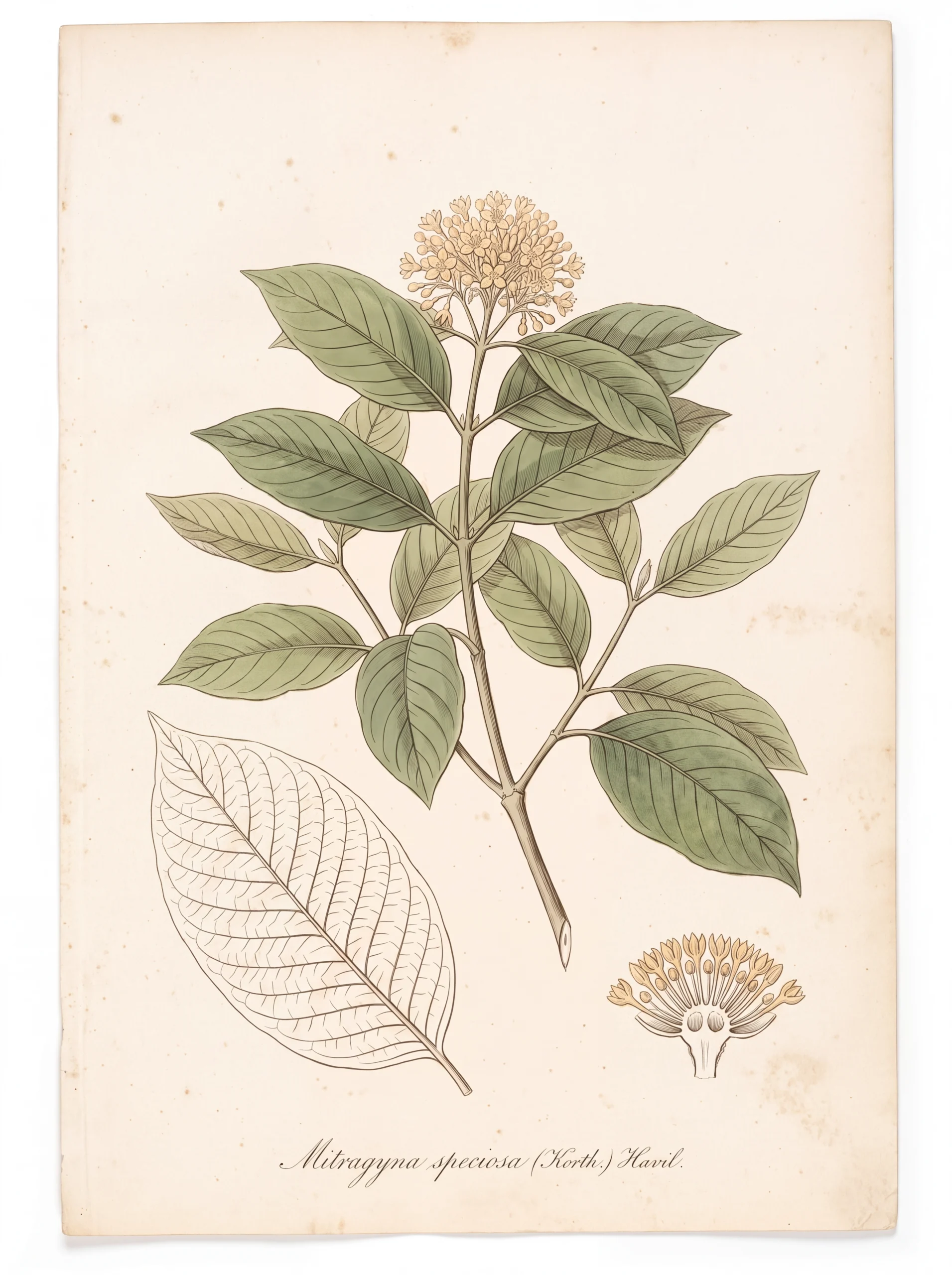
Botanical illustration of Mitragyna speciosa showing a flowering branch, the leaf venation, and a cross-section of the flower head
Mitragyna speciosa, drawn in the manner of a nineteenth century botanical plate.
The Producing Countries

Three countries, three different centuries.

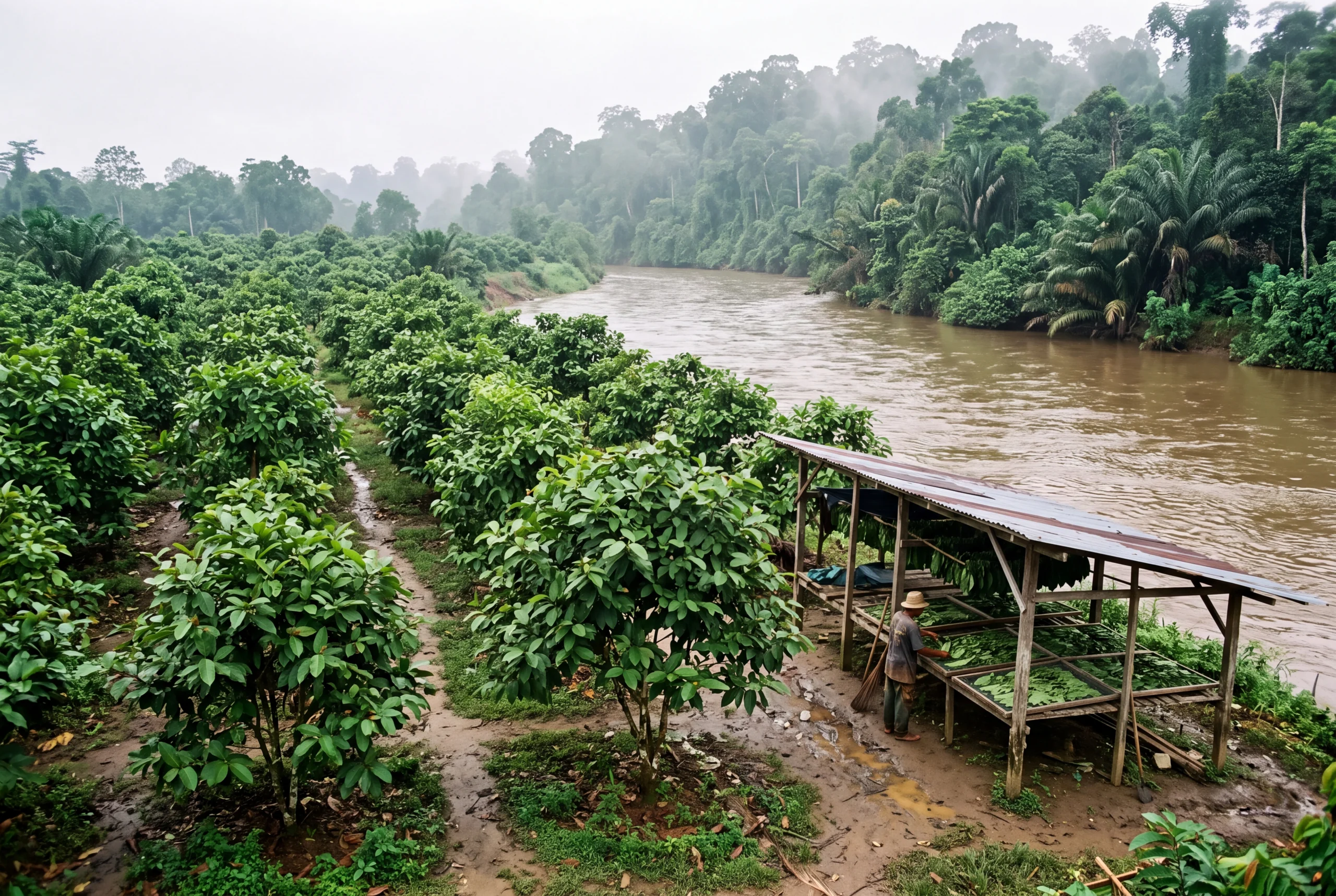
Rows of kratom trees on a riverbank smallholding, with harvested leaf laid out under a covered drying rack

Indonesia

The centre of the modern trade

Borneo and Sumatra carry the bulk of world production. Leaf is grown and wild-harvested along the Kapuas and its tributaries, dried under cover, deveined, milled, and shipped out through West Kalimantan. Indonesia became the dominant exporter by default after Thailand removed itself from the market in 1943, and it has held that position ever since.

  • Kalimantan, Sumatra, Riau, Aceh
  • Family and smallholder farms
  • Dominant exporter since the 1940s
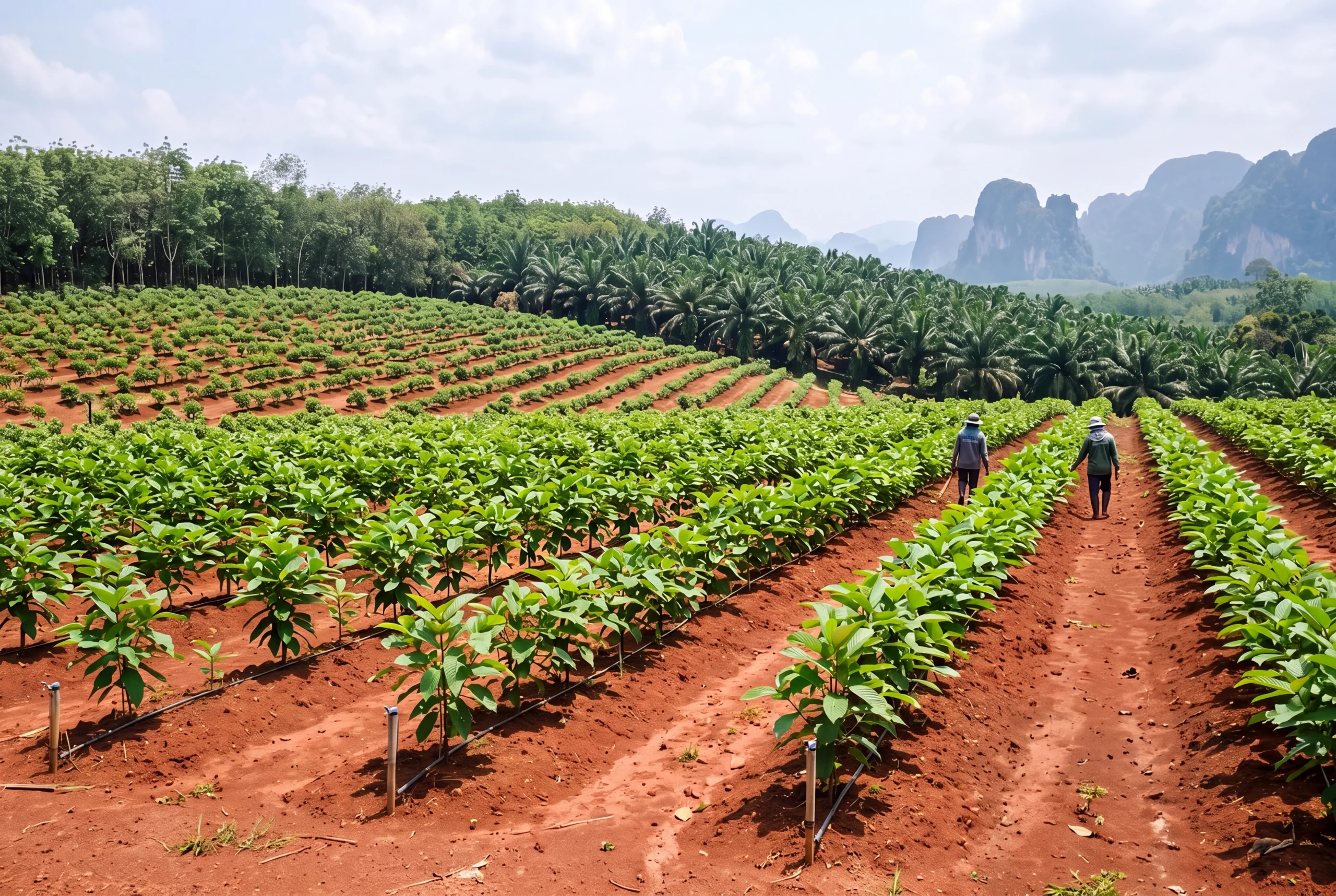
Young kratom trees planted in irrigated rows on red soil, with limestone hills behind

Thailand

Where the word comes from

Kratom is a Thai word, and southern Thailand is where the tree first entered the written legal record. Eighty years of prohibition from 1943 ended in 2021, and the southern provinces of Surat Thani, Trang, and Nakhon Si Thammarat are planting again under an agricultural licensing regime.

  • Southern provinces
  • Prohibited 1943 to 2021
  • Legal crop, licensed and expanding
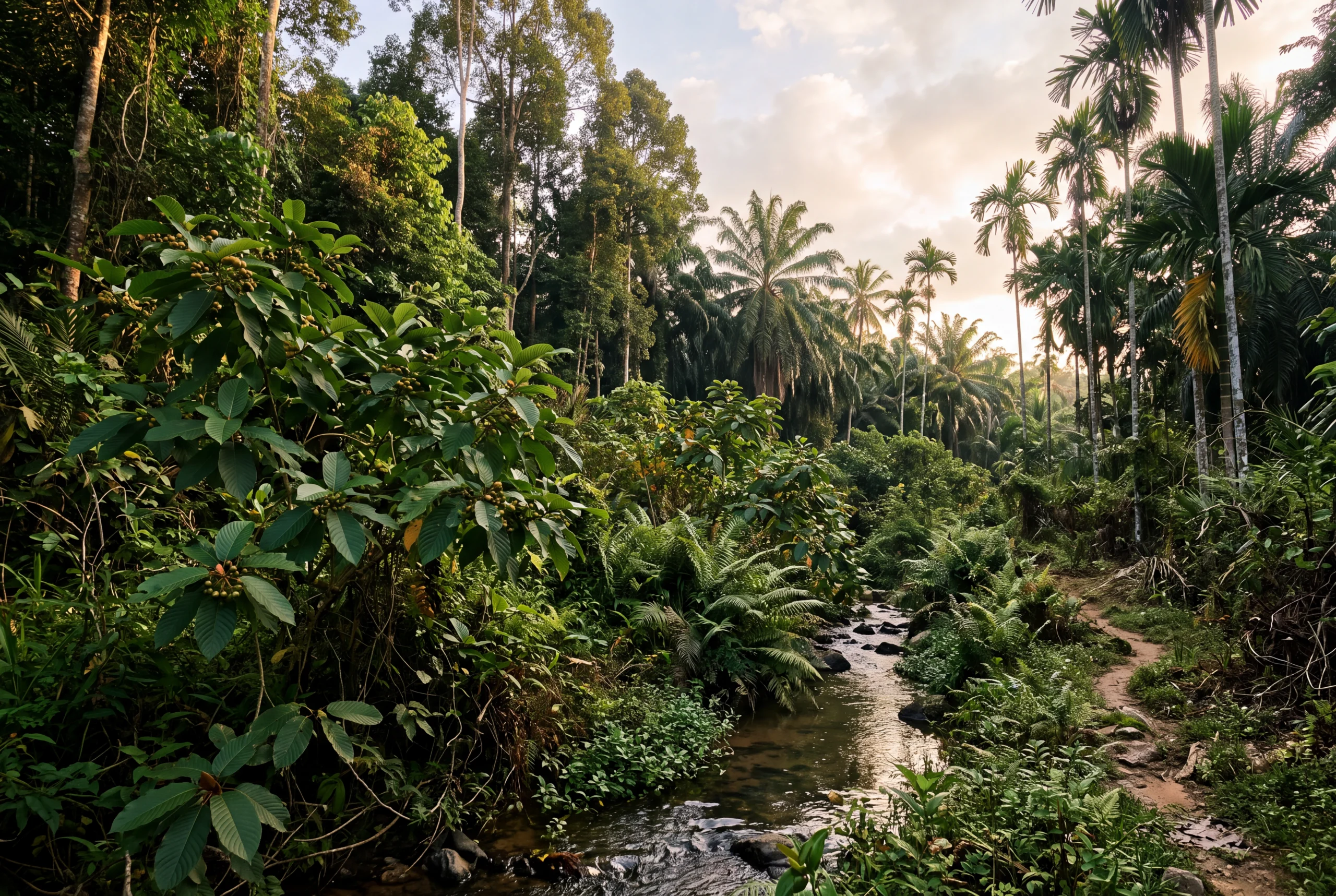
Kratom growing wild at a lowland forest edge beside a stream, among palms and ferns

Malaysia

Known as ketum

Peninsular Malaysia grows kratom across Kedah, Perak, and Kelantan, where it is called ketum or biak-biak. Regulation under the Poisons Act keeps commercial activity restricted, so Malaysian leaf rarely reaches the international market despite the country sitting inside the tree's natural range.

  • Kedah, Perak, Kelantan
  • Regulated under the Poisons Act
  • Little to no export
Names and Trade Terms

Why the strain names lie about geography.

Kratom strain names come from the export trade, not from botany. A century of shifting routes and shifting legality left behind a vocabulary in which the place on the label is often the place the leaf passed through, or a grading term, rather than where it grew.

Kratom, ketum, biak-biak

One tree, three regional names. Kratom is Thai, ketum and biak-biak are Malay. Indonesian growers more often use the botanical name or a regional descriptor.

Bali

A route, not an origin. Bali strains are Borneo-grown leaf named for the historic export route that moved it, which is why Bali the island has never been a kratom producer of any scale.

Maeng Da

A Thai trade grade meaning roughly "pimp grade", used in the market to flag a seller's premium lot. It travelled with the trade to Indonesia, so Maeng Da leaf today is typically Kalimantan leaf.

Hulu

Indonesian for the upriver reaches. Hulu Kapuas leaf is named for where on the Kapuas it was grown, making it one of the few trade names that still describes a real place.

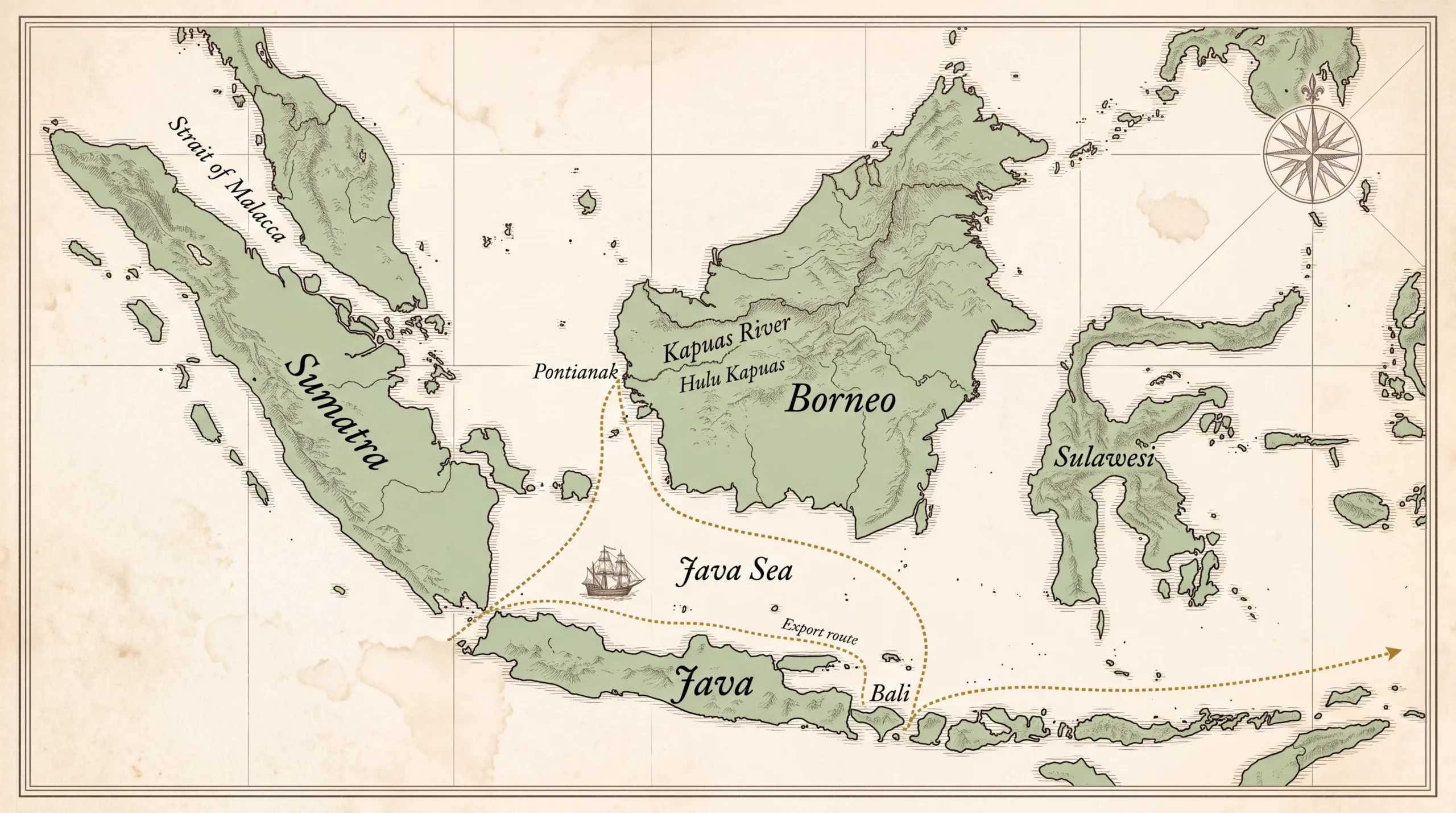
Antique-style map of the Indonesian archipelago tracing a dotted export route from Pontianak on the west coast of Borneo across the Java Sea, past Bali, and out to sea
Leaf from the Kapuas basin ships out through Pontianak. The route it travelled, not the island, is where the Bali name comes from.
History FAQ

Common questions, answered straight.

Where does kratom originally come from?

Mitragyna speciosa is native to the lowland tropics of Southeast Asia, across Borneo, Sumatra, Peninsular Malaysia, southern Thailand, Myanmar, and New Guinea. Today the overwhelming majority of commercial leaf is grown in Indonesia, concentrated in West Kalimantan along the Kapuas river system.

How long has kratom been documented?

The genus was described botanically in 1839 by the Dutch botanist Pieter Willem Korthals, and the accepted binomial Mitragyna speciosa was established by George Darby Haviland in 1897. The first alkaloid extraction was reported in 1907, and mitragynine was isolated and named in 1921.

Why was kratom banned in Thailand in 1943?

The Kratom Act 1943 prohibited planting new trees and ordered existing ones cut down. Accounts of the period describe it as a revenue and trade control measure rather than one based on any assessment of the plant. Its practical effect was to move cultivation and the export trade to Indonesia.

Is kratom legal in Thailand now?

Yes. Thailand removed kratom from its narcotics list in August 2021 and vacated convictions under the previous law. Follow-up legislation regulates it as a controlled agricultural crop, and Thai farmers are growing and trading it legally again after eighty years.

Why are kratom strains named after places they are not grown in?

Because most strain names are trade terms rather than origins. Bali refers to a historic export route, not the island; Maeng Da is a Thai grading term that travelled to Indonesia with the trade. Names that do describe real places, such as Hulu Kapuas, Ketapang, and Aceh, are the exception.

This page is botanical, agricultural, trade, and regulatory history, not medical or legal advice. The photographs, maps, and botanical plate on this page are illustrations, not records of specific farms or historical documents. Kratom products are not intended to diagnose, treat, cure, or prevent any disease. These statements have not been evaluated by the FDA.

Stay in the Loop

No spam. Unsubscribe anytime. Prefer real-time? Join us on Discord.

HVB App

HVB App Available

Faster browsing, exclusive deals & push notifications

Open App

Welcome!

You must be 21+ to purchase Kratom products
You must be 18+ to purchase Botanicals products

I am I am not

Remember Me
Disclaimer: Kratom: FDA DISCLAIMER: The statements made regarding these products have not been evaluated by the Food and Drug Administration. The efficacy of these products has not been confirmed by FDA-approved research. These products are not intended to diagnose, treat, cure, or prevent any disease. KRATOM DISCLAIMER: “This product is not available for shipment to the following states: Alabama, Arkansas, Indiana, Wisconsin, Connecticut, Utah, Tennessee, Kansas, North Dakota, Massachusetts; or the following counties: Sarasota County (Florida), San Diego (California), Oceanside (California), Alton (Illinois), Jerseyville (Illinois), Edwardsville County (Illinois), Columbus (Mississippi), Union County (Mississippi), Ascension (Louisiana), Franklin (Louisiana), Rapides (Louisiana)”. Our products are not for use by or sale to persons under the age of 21. WAAVE ALSO RESPECTS COMPLIANCE IN THE FOLLOWING STATES AND COUNTIES: Vermont, Louisiana. Denver CO, Washington D.C., Newport Beach CA, Malheur County, Parker & Monument (CO), Grant Parish (LA), Franklin (NH) and several other counties in Mississippi. We do not ship internationally. ID verification is required for shipments to the following states: Florida, Virginia, West Virginia, Colorado, Oregon, South Dakota, Nebraska, Kentucky, Maryland, Tennessee, Mississippi, Georgia, Rhode Island. Enhanced Kratom cannot be shipped to Tennessee and Georgia. Kratom is NOT used to treat, cure, or mitigate any disease, illness, ailment, and/or condition. Please consult your doctor before consuming any new products. Kratom has not been tested on pregnant women. Please, see the FDA alert 54-15. We make no representations as to intended use or suitability for use. This product contains chemicals known to the state of California to cause cancer, birth defects, or reproductive harm. Specifically nickel, arsenic, and lead. For more information please visit p65warnings.ca.gov. We do not ship to military bases
- Botanicals: We respect federal state and city laws, our shipping restrictions are detailed below on the footer and they are automatically updated by WAAVE compliance FDA Disclaimer: The statements made regarding our products have not been evaluated by the Food and Drug Administration. The efficacy of these products has not been confirmed by FDA-approved research. We assume no responsibility for the improper use of our products. These products are not intended to diagnose, treat, cure or prevent any disease. All information presented here is not meant as a substitute for or alternative to information from health care practitioners. Please consult your health care professional about potential interactions or other possible complications before using any product. The Federal Food, Drug, and Cosmetic Act requires this notice. Merchants may not ship to military bases.
 

WAAVE Compliance