Video series
Kratom leaf and 7-OH,explained for officials.
Short videos for officials weighing an outright ban on kratom. Each part takes one question that comes up at hearings and walks through the sources behind the answer. The sources are on screen in every video and listed under each part here, with the full transcript.
Note: this brief was checked September 30, 2026. Its DEA figures describe the July 2026 proposal, which was replaced on October 9. See the update on the explainer series page.
All 6 parts, the complete series. Facts checked September 27 to 29, 2026.
Part 1 · 3:55
Where the line is drawn.
The difference between kratom leaf and the concentrated and synthetic 7-OH products behind the headlines: how little 7-OH the leaf holds, how the concentrates are made, and how threshold laws draw the line at concentration instead of at the plant.
Transcript
This is Part 1 of a short series on kratom, from Hudson Valley Botanicals, a kratom business that sells leaf products only and has a financial interest in how kratom is regulated. This part covers one distinction: the leaf, versus the concentrated and synthetic products behind the headlines.
Kratom is a tree native to Southeast Asia. Its leaf contains more than fifty alkaloids, and the main one is mitragynine. Another, 7-hydroxymitragynine, or 7-OH, is a minor part. The FDA puts it under two percent of the leaf’s alkaloids, typically a few hundredths of one percent of the dried leaf’s weight.
The products in the headlines are different: tablets, shots and gummies built around 7-OH itself. The leaf holds too little 7-OH to extract economically, so the FDA says this 7-OH is likely made by chemically converting mitragynine. In testing the FDA cited, one pill held 15 milligrams, about what 40 to 150 grams of dried leaf contain.
The body does convert some of the leaf’s mitragynine into 7-OH, gradually. Concentrates skip that step. And when you hear that 7-OH is many times stronger than morphine, that figure comes from lab studies of the isolated compound, not the leaf.
Then there are lab-made relatives of 7-OH, like MGM-15 and MGM-16. On August 26, the DEA placed three of them in temporary Schedule I at any amount, and a local law can name them too, along with similar compounds developed later.
So the line is being drawn at concentration, not at the plant. In July, the DEA proposed 0.05 percent for plant material, and 0.05 percent or one milligram for processed products. Some governments have chosen this line over a ban. Rhode Island replaced its statewide ban with a regulated market that caps 7-OH at one percent of total alkaloids and one milligram per serving. And the Kratom Consumer Protection Act, a model law many states have adopted in some form, caps 7-OH at two percent of total alkaloids. That’s two percent of the alkaloids, not two percent of the plant.
Enforcement doesn’t need a chemistry lab at every counter. An independent lab certificate shows each lot’s 7-OH content, and inspectors check the paperwork. Leaf isn’t risk-free, which is why a threshold law can also set a minimum age of 21 and require warning labels.
If you’re weighing an outright ban, there’s a narrower option: a threshold law that takes concentrated and synthetic 7-OH products off the shelves, while plain leaf stays legal under age limits, labeling and testing. Thank you for watching. Part 2 is coming soon.
Update, October 14, 2026: This part describes the DEA’s July 2026 proposal for 7-OH, which DEA is withdrawing after HHS recommended new limits. See the update at the top of this page for the new notice.
Sources (11)
- FDA, "7-Hydroxymitragynine (7-OH): An Assessment of the Scientific Data and Toxicological Concerns Around an Emerging Opioid Threat" (July 2025), including the product testing it cites
- FDA, "FDA and Kratom"
- DEA, temporary scheduling order for MGM-15, MGM-16 and MP (Federal Register, August 2026)
- DEA, notice of intent on 7-OH thresholds (Federal Register, July 2026). A proposal, not yet final when checked on September 27, 2026. Withdrawn October 9, 2026.
- Congressional Research Service, "Temporary Control of 7-Hydroxymitragynine (7-OH) and Related Substances Under the Controlled Substances Act" (Legal Sidebar LSB11457)
- Rhode Island Kratom Act, R.I. Gen. Laws § 21-28.12-3
- Kratom Consumer Protection Act, model text
- Dutchess County Local Law No. 6 of 2026 (introduced as Resolution 2026136; passed August 10, 2026; signed September 2026)
- U.S. Department of Justice, press release on updates to the 7-OH emergency scheduling actions, October 9, 2026
- DEA notice of intent, docket DEA-1570, "Schedules of Controlled Substances: Temporary Placement of 7-Hydroxymitragynine and Mitragynine Pseudoindoxyl Above a Specified Threshold in Schedule I," 91 FR 65370 (October 14, 2026), FR Doc. 2026-20943
- HHS press release, "HHS Recommends Science-Based Thresholds to Target Dangerous Enhanced Kratom Products" (October 9, 2026)
Part 2 · 2:21
What the numbers measure.
The number officials hear most often at kratom hearings is the CDC's 1,200% increase in kratom reports to poison centers. This part shows what that number counts, what it does not, and what the report's authors say the data cannot show.
Transcript
This is Part 2 of a short series on kratom, from Hudson Valley Botanicals, a kratom business that sells leaf products only and has a financial interest in how kratom is regulated. This part looks at the number you’ll hear most often at kratom hearings.
That number is a 1,200% increase. It comes from a CDC report on calls to poison centers: 258 kratom reports in 2015, and 3,434 in 2025.
A report is a call to a poison center about actual or suspected contact with a substance, whether or not anyone had symptoms. So the 1,200% is a count of calls, not a count of injuries or deaths.
Over the same 11 years, the report counted 233 deaths. 79% involved other substances as well, most often opioids.
Reports involving kratom alone make up most of the total. They had leveled off from 2020 through 2024. Then, in 2025, they rose sharply. Those reports deserve to be taken seriously.
What the data can’t show is which products people used. The authors note that it doesn’t record whether a report involved traditional leaf or concentrated 7-OH, and that the 2025 surge coincides with the arrival of those concentrates. They recommend that surveillance tell product types apart.
So the numbers show a real rise, but not which products drove it. Separating leaf from concentrates, in the data and in the law, is how to target the harm. Thank you for watching. Part 3 is coming soon.
Part 3 · 2:50
How a threshold law is enforced.
Legislators weighing a threshold law often ask how it would be enforced. This part covers the lab paperwork a threshold law can require, the four things an inspector checks at the counter, what happens when something does not match, and what Utah and Rhode Island already do.
Transcript
This is Part 3 of a short series on kratom, from Hudson Valley Botanicals, a kratom business that sells leaf products only and has a financial interest in how kratom is regulated. This part answers a question legislators ask about threshold laws: how would we enforce it?
A threshold law caps how much 7-OH a kratom product can contain. Enforcing it starts with paperwork. The law can require a certificate of analysis from an independent, accredited lab for every lot. The certificate lists the product’s alkaloids, including 7-OH, and ties back to the lot number printed on the package.
An inspector doesn’t need a lab at the counter. They check 4 things. Is the product sold as 7-OH, often as tablets, shots or gummies? Does the package carry a lot number? Does the certificate match that lot? And is 7-OH under the legal limit?
If something doesn’t match, the product can be pulled and sent to an accredited lab, which can measure 7-OH directly. These checks can ride along with inspections health departments already do.
Rhode Island isn’t alone. Utah, for example, requires kratom products to be registered with the state, with a certificate of analysis for each batch. Rhode Island already has pieces of this in place. Since April 1, 2026, stores there need a state license to sell kratom, and everyone who sells it must first complete training on the law.
The state health department can have a kratom product tested by an independent lab of its choosing, and the retailer pays for the test. Fines run up to $1,000 for a first offense and $2,000 for a second, and a third means the retailer loses its license. Products that break the law can be seized. In May 2026, state health inspectors removed 6 containers of kratom products from a store that had no license to sell kratom.
Clear limits, lab paperwork for every lot, and routine inspections make a threshold enforceable without a chemistry lab at every counter. Thank you for watching. Part 4 is coming soon.
Sources (7)
- Utah Code § 4-45-108 (kratom product registration)
- Utah Administrative Code R70-580-3 and R70-580-5 (registration with a certificate of analysis, and the certificate for each batch)
- R.I. Gen. Laws § 21-28.12-6 (licenses required)
- Rhode Island Department of Health, "Rhode Island Kratom Application Requirements" (2026), including the training required before selling
- R.I. Gen. Laws § 21-28.12-5 (testing by a laboratory the department chooses, fines, license revocation)
- R.I. Gen. Laws § 21-28.12-5.1 (seizure of kratom products held for sale in violation of the law)
- Rhode Island Department of Health, "Rhode Island Retailers Reminded About Kratom Requirements" (press release, May 13, 2026)
Part 4 · 3:11
What the 2% means.
Many 7-OH limits turn on one number, 2%. This part explains where it comes from, what it is 2% of, why the same line can be written as 2% or as 0.05%, and why a limit written as 2% by weight is a very different law.
Transcript
This is Part 4 of a short series on kratom, from Hudson Valley Botanicals, a kratom business that sells leaf products only and has a financial interest in how kratom is regulated. This part explains the number at the center of many 7-OH limits: 2%, and what it’s 2% of.
The 2% matches the leaf itself. In its 2025 assessment, the FDA reported that 7-OH makes up less than 2% of the total alkaloids in natural kratom leaves. The model state law, the Kratom Consumer Protection Act, sets its limit at that level: no product where 7-OH is more than 2% of the alkaloids.
That’s 2% of the alkaloids, not 2% of the plant. The alkaloids are a small part of the leaf: the main one, mitragynine, is only about 1% to 2% of its weight. 7-OH is a sliver of the alkaloids. By weight, natural leaf contains only trace amounts, up to about 0.04% in published measurements.
So for leaf, the line can be drawn two ways. The model law measures 7-OH against a product’s alkaloids: 2%. The DEA’s proposed limit for plant material measures it against the leaf’s dry weight: 0.05%. Different numbers, same idea: both sit just above what natural leaf contains.
The unit matters. A limit of 2% of a product’s weight is about 50 times the top of the range published studies report for natural leaf. 7-OH products tested in a recent lab study measured 2.2% to 7.5% of their weight, so a limit written that way sits almost at the bottom of their range.
Some laws, like Rhode Island’s, and the DEA’s proposal, also add a second test: a 1 mg cap on 7-OH in a serving or product. It’s aimed at concentrated products, like the pressed pill the FDA reported with 15 mg, 15 times that cap.
So when a bill says 2%, ask: 2% of what? 2% of the alkaloids draws the line just above what natural leaf contains. 2% of a product’s weight draws it about 50 times higher. Thank you for watching. Part 5 is coming soon.
Update, October 14, 2026: This part describes the DEA’s July 2026 proposal for 7-OH, which DEA is withdrawing after HHS recommended new limits. See the update at the top of this page for the new notice.
Sources (10)
- FDA, "7-Hydroxymitragynine (7-OH): An Assessment of the Scientific Data and Toxicological Concerns Around an Emerging Opioid Threat" (July 2025)
- Kratom Consumer Protection Act, model text (its limit on 7-hydroxymitragynine in the alkaloid fraction)
- DEA, notice of intent, "Temporary Placement of 7-Hydroxymitragynine Above a Specified Threshold in Schedule I," 91 FR 40917 (July 6, 2026). A proposal, not yet final when checked on September 29, 2026. Withdrawn October 9, 2026.
- New York State Department of Health, "Kratom: What Clinicians Need to Know" (revised December 2025)
- Brown et al., "Elevated 7-Hydroxymitragynine Levels Found in Products Misbranded as Kratom," Journal of AOAC International 109(1), pages 124 to 130 (2026)
- Todd et al., Scientific Reports (2020)
- R.I. Gen. Laws § 21-28.12-3 (product limits, including the 1 mg cap)
- U.S. Department of Justice, press release on updates to the 7-OH emergency scheduling actions, October 9, 2026
- DEA notice of intent, docket DEA-1570, "Schedules of Controlled Substances: Temporary Placement of 7-Hydroxymitragynine and Mitragynine Pseudoindoxyl Above a Specified Threshold in Schedule I," 91 FR 65370 (October 14, 2026), FR Doc. 2026-20943
- HHS press release, "HHS Recommends Science-Based Thresholds to Target Dangerous Enhanced Kratom Products" (October 9, 2026)
Part 5 · 2:49
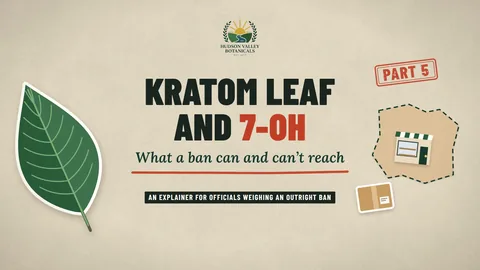
What a ban can and can’t reach.
Officials weighing an outright ban usually hear about what a ban is meant to stop. This part looks at what a local ban can actually reach: store shelves, online orders, purchases in the next town or county, personal possession, and the room state and federal law leave a local government. It is framed as questions for an attorney and is not legal advice.
Transcript
This is Part 5 of a short series on kratom, from Hudson Valley Botanicals, a kratom business that sells leaf products only and has a financial interest in how kratom is regulated. This part looks at what an outright local ban can and can’t reach. It isn’t legal advice. These are questions for a local government’s attorney.
A local ban reaches the stores inside the city, town, village or county that passes it. Products come off the shelves, and sellers face fines, confiscation, and in some places criminal charges. That’s the part a local government controls directly.
Online orders are harder. Some local laws cover deliveries coming in, and some online sellers block orders to places with bans. Whether a local government can enforce its law against a seller in another state is a question for its attorney.
Many local bans cover selling kratom, not owning it. So a sale-only ban doesn’t stop residents from buying it in the next town or county. A ban that covers possession goes further. It reaches residents, not just stores.
What a local government can do also depends on its state. Some states have their own kratom laws, and a local ban may conflict with them. That’s another question for counsel. Under federal law, kratom leaf is not a controlled substance, and the FDA says its action on 7-OH is not focused on natural leaf products.
At least two states have replaced a kratom ban with a law that regulates it. Rhode Island made kratom legal in April 2026, for licensed retailers to sell to adults 21 and older, with 7-OH concentrates prohibited. North Dakota banned all kratom by emergency order in August 2026. A month later it passed a law that bans synthetic 7-OH and, once its rules take effect, allows natural kratom for adults 21 and older.
So before a vote on a ban, it’s worth asking counsel: Does it cover delivery? Does it cover possession? Can it reach sellers in other states? And does state law leave room for it? Thank you for watching. Part 6 is coming soon.
Sources (6)
- Local kratom laws and orders adopted or proposed in New York in 2026 (the filed texts are on our advocacy documents page)
- DEA, "Withdrawal of Notice of Intent to Temporarily Place Mitragynine and 7-Hydroxymitragynine Into Schedule I," 81 FR 70652 (October 13, 2016)
- FDA press release, "FDA Takes Steps to Restrict 7-OH Opioid Products Threatening American Consumers" (July 29, 2025)
- Rhode Island Kratom Act, R.I. Gen. Laws chapter 21-28.12 (effective April 1, 2026)
- North Dakota Governor’s Office, executive order on kratom (August 3, 2026)
- North Dakota Governor’s Office, House Bill 1628 signed (September 4, 2026)
Part 6 · 2:54
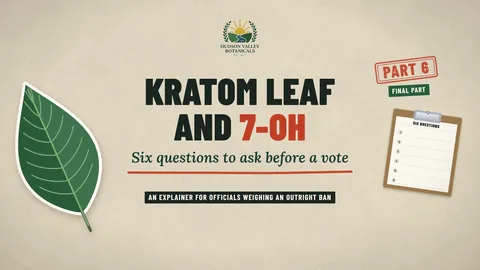
Six questions to ask before a vote.
The last part sums up the series as six questions an official can ask about any kratom bill: whether it separates the leaf from concentrated and synthetic 7-OH products, what the numbers behind it measure, how it will be enforced, what a 7-OH limit is a percentage of, what it can reach, and how it keeps kratom away from young people.
The six questions are also a three-page brief to print or hand out, with the key numbers and sources: download the brief (PDF). Note: this brief was checked September 30, 2026. Its DEA figures describe the July 2026 proposal, which was replaced on October 9. See the update on the explainer series page.
Transcript
This is Part 6 of a short series on kratom, from Hudson Valley Botanicals, a kratom business that sells leaf products only and has a financial interest in how kratom is regulated. This last part sums up the series in six questions to ask before a vote on kratom.
One: does the bill separate the leaf from concentrated and synthetic 7-OH products? Federal agencies’ actions on 7-OH do. The FDA says its action is not focused on natural kratom leaf products, and the DEA’s proposal doesn’t apply to leaf below its threshold.
Two: what do the numbers behind the bill measure? A poison center report is a call about actual or suspected contact with a substance, whether or not anyone had symptoms. And the CDC’s authors note that their data can’t tell leaf from concentrated 7-OH.
Three: how will it be enforced? A lab certificate for every lot, matched to the lot number on the package, lets an inspector check each product’s paperwork without a lab at the counter.
Four: if there’s a 7-OH limit, what is it a percentage of? 2% of the alkaloids sits just above what natural leaf contains. 2% of a product’s weight is about 50 times higher.
Five: what can it reach? Store sales, yes. Delivery, possession and sellers in other states depend on how it’s written, and on state law.
Six: how does it keep kratom away from young people? New York already bars kratom sales to anyone under 21 and requires an ID check. Colorado, Rhode Island and North Dakota set the same age limit and bar products or packaging that appeal to children. Colorado and Rhode Island also keep kratom out of reach in stores.
A law that answers these six questions can go after the concentrated and synthetic 7-OH products federal agencies are targeting, while keeping natural leaf legal and regulated for adults. Thank you for watching. All six parts, with their sources, are on the Hudson Valley Botanicals website.
Update, October 14, 2026: This part describes the DEA’s July 2026 proposal for 7-OH, which DEA is withdrawing after HHS recommended new limits. See the update at the top of this page for the new notice.
Sources (15)
- FDA press release, "FDA Takes Steps to Restrict 7-OH Opioid Products Threatening American Consumers" (July 29, 2025)
- DEA press release, "DEA to Temporarily Schedule 7-OH and Related Substances to Protect Public Safety" (July 1, 2026). The 7-OH threshold is a proposal, not yet final when checked on September 29, 2026. Withdrawn October 9, 2026.
- CDC, Morbidity and Mortality Weekly Report 75(11), March 26, 2026 (Towers et al., the source for Part 2)
- Enforcement: the model and its sources are in Part 3
- The 2%: FDA (2025), the Kratom Consumer Protection Act model text, Brown et al. (2026) and Todd et al. (2020), all in Part 4
- What a ban can reach: the examples and sources are in Part 5
- New York S4552A, Chapter 690 of the Laws of 2025 (no kratom sales to anyone under 21)
- New York S8814, Chapter 81 of the Laws of 2026 (amends it; Public Health Law § 1399-xx, in force since June 2026)
- Colorado SB25-072 (signed May 29, 2025)
- Rhode Island Kratom Act, R.I. Gen. Laws chapter 21-28.12 (effective April 1, 2026)
- Rhode Island Department of Health, "Rhode Island Retailers Reminded About Kratom Requirements" (press release, May 13, 2026)
- North Dakota Governor’s Office, House Bill 1628 signed (September 4, 2026)
- U.S. Department of Justice, press release on updates to the 7-OH emergency scheduling actions, October 9, 2026
- DEA notice of intent, docket DEA-1570, "Schedules of Controlled Substances: Temporary Placement of 7-Hydroxymitragynine and Mitragynine Pseudoindoxyl Above a Specified Threshold in Schedule I," 91 FR 65370 (October 14, 2026), FR Doc. 2026-20943
- HHS press release, "HHS Recommends Science-Based Thresholds to Target Dangerous Enhanced Kratom Products" (October 9, 2026)
Hudson Valley Botanicals sells kratom and is affected by these laws, so watch with that interest in mind. The videos are public commentary, not legal advice, and nothing in them or on this page describes what any product does. Laws and proposals change; each part lists its sources so they can be checked.