Botanical guideMitragyna speciosaLab-tested, sourced direct
The Plant · Mitragyna speciosa
Mitragyna speciosa,explained without the fluff.
Kratom is a tropical evergreen in the coffee family, native to Southeast Asia. This page covers what it is, where it grows, the alkaloids the leaf contains, how it is harvested and processed, and how to tell quality leaf from filler. Straight botany and sourcing, no marketing claims.
Coffee-family evergreen
40+ documented alkaloids
Indonesian archipelago
Documented since the 1800s
Rubiaceae family
Origin & History
A Southeast Asian staple, centuries in the making.
Long before kratom reached the Western market, families across Indonesia, Thailand, and Malaysia were working with the leaf as part of daily life.
Indonesia
The Indonesian archipelago, especially Borneo (Kalimantan) and Sumatra, is the beating heart of modern kratom cultivation. Family farms harvest wild and cultivated trees along rivers like the Kapuas, drying the leaf in covered sheds to protect it from direct sun.
Kalimantan, Sumatra, Riau
Wild and smallholder plots
Dominant exporter today
Thailand
Thai laborers chewed fresh leaves during long work days in the fields as far back as the 1800s, and the plant was woven into village ceremonies. Thailand removed kratom from its controlled substances list in 2021 and is once again producing leaf legally.
Southern provinces: Surat Thani, Trang
Traditional fresh-leaf use
Legal and expanding since 2021
Malaysia
Known locally as ketum, Malaysian kratom grows across Peninsular Malaysia, especially in Kedah and Perak. Communities have brewed the leaf as a tea for generations. Regulation remains strict, so Malaysian kratom rarely reaches international markets.
Kedah, Perak, Kelantan
Known regionally as ketum
Domestic use, limited export
Botanical Profile
The leaf, up close. Anatomy and chemistry.
Kratom is a slow-growing tree that reaches 40 to 80 feet in mature stands. The leaves do the work.
Leaf Anatomy
Dark glossy leaves, elliptical in shape, typically 4 to 7 inches long. The central vein runs the length of the leaf and shifts color as the leaf matures, from white through green to red. That vein color is the starting point for every strain classification.
Habitat
Native to humid equatorial lowlands, kratom thrives in rich alluvial soil along rivers and in secondary rainforest. The tree grows wild across Indonesia, Thailand, Malaysia, Myanmar, and Papua New Guinea. Nearly all commercially traded leaf today comes from Indonesia.
Alkaloid Compounds
Researchers have identified more than 40 alkaloids in the leaf. The two most studied are mitragynine, which typically makes up 60 to 70 percent of the total alkaloid content, and 7-hydroxymitragynine, a trace alkaloid often present at less than 2 percent. Secondary alkaloids include speciogynine, speciociliatine, paynantheine, and corynantheidine.
Plant Family
Kratom belongs to the Rubiaceae family, a large flowering-plant family that also includes coffee (Coffea arabica), cinchona (source of quinine), and gardenia. Like its relatives, the tree is rich in indole alkaloids, which is why its chemistry has been documented for more than a century.
Alkaloid Spotlight
Mitragynine
~60 to 70%of total alkaloids
The most abundant alkaloid in most commercial leaf. First isolated in 1907 by Dutch botanist Hooper and later confirmed by D. Hooper and E. Field in the 1920s.
7-Hydroxymitragynine
<2%of total alkaloids
A trace oxidative product of mitragynine. Present in fresh leaf in very small amounts and increases modestly with drying and age.
Secondary alkaloids
~30%combined
Speciogynine, speciociliatine, paynantheine, corynantheidine, mitraphylline. Each contributes to the leaf's unique alkaloid fingerprint.
Vein Colors
Five vein colors, one species.
Vein color describes the leaf's maturity and the drying method the farmer used. It is not a separate plant.
White Vein
Youngest leaves · Shortest dry
Harvested from young trees or early-growth leaves. Dried indoors with minimal light exposure, preserving the lighter alkaloid profile tied to immature leaf.
Green Vein
Mid-maturity · Balanced dry
The middle point in the harvest cycle. Green vein leaf is dried part indoors and part outdoors, producing a balanced alkaloid ratio that sits between white and red.
Red Vein
Most mature · Longest dry
Harvested at full maturity when the central vein turns deep red. Dried longer, often with a final sun-cure, which shifts the alkaloid balance compared to younger leaf.
Yellow Vein
Extended dry · Regional
Not a separate harvest. Yellow is produced by drying green or white leaf for a longer period, often with controlled sun exposure, until the powder takes on a yellow-gold hue.
Gold Vein
Fermented · Specialty
A specialty process where red leaf is briefly fermented before drying. The result is a distinct alkaloid ratio and a visibly darker powder, often with a copper or gold tint.
Same tree, same species. What changes is when the leaf is picked and how the farmer chooses to dry it. For a deeper comparison, see our strain guide.
Available Forms
Three ways the leaf reaches your doorstep.
The plant arrives whole-leaf, then we decide how it gets milled, packed, and shipped.
Powder
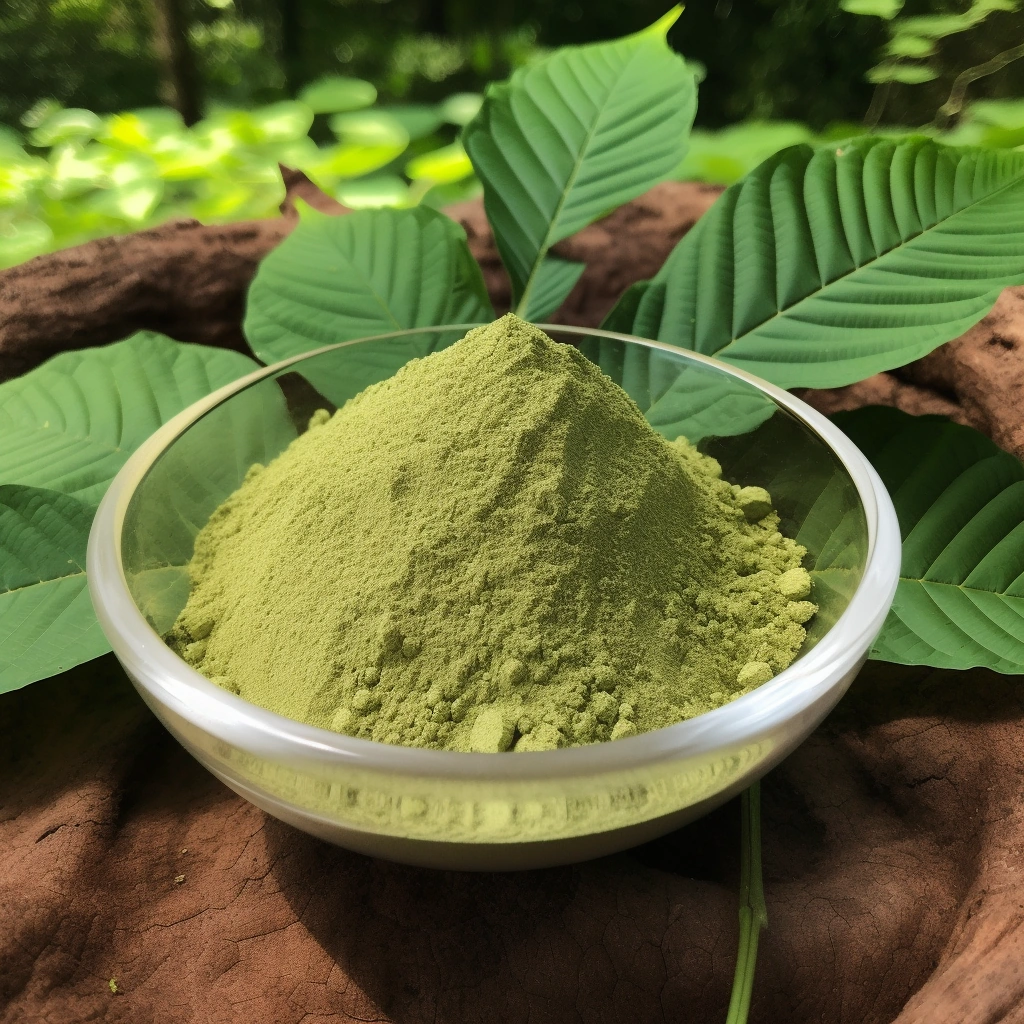
Dried leaf, deveined and milled to a fine powder. The standard form across the industry because it preserves the whole-leaf alkaloid profile and stores well. Sold by weight, typically in 28 g, 125 g, 250 g, 500 g, and 1 kg pouches.
Whole-leaf alkaloid profile
Long shelf life in sealed bags
Measured by weight, not volume
Capsules
The same milled powder packed into standardized vegetable-cellulose capsules. Capsules are pre-measured by the gram and offer consistent portioning. The only difference from loose powder is the vegetable-cellulose shell.
Pre-measured portions
Vegetable cellulose shell, no gelatin
Taste-neutral
Extracts
A concentrated form produced by soaking leaf in food-grade solvent, filtering, and evaporating until only a thick resin or spray-dried powder remains. Extracts are measured in total-alkaloid percent and are much stronger per gram than leaf. Handled and labeled differently for that reason.
Concentrated alkaloid content
Liquid, resin, or spray-dried
Labeled by potency, not weight alone
Quality Markers
What separates good leaf from filler.
If a vendor can't answer these six questions, the pouch is a guess.
01
Third-party testing
Every batch should be tested by an independent ISO 17025-accredited lab for alkaloid content, heavy metals (lead, cadmium, arsenic, mercury), microbials (Salmonella, E. coli, yeast, mold), and pesticides. Ask for the COA by batch number. If there isn't one, there wasn't a test.
02
Sourcing transparency
Quality vendors know the region, the farm, and often the family. "Indonesian" is not sourcing transparency. "Harvested in the Kapuas Hulu regency of West Kalimantan by the family we've worked with since 2019" is.
03
Freshness & harvest date
Kratom is a dried botanical. Alkaloid content degrades gradually over time, especially with light and heat exposure. A fresh batch, stored sealed and cool, will outperform a year-old pouch every time. Look for vendors who date their batches.
04
Milling & cleanliness
Fine, uniform powder means the leaf was properly dried and milled. Stem and vein content should be minimal. Color should be consistent within the vein type. Clumping, gritty textures, or off smells are warning signs.
05
Packaging
Quality leaf ships in sealed, opaque, moisture-barrier pouches with a clear batch number and a matching COA. Clear bags, missing labels, or unsealed packaging all shorten the product's useful life.
06
AKA GMP qualification
The American Kratom Association's Good Manufacturing Practices Standards Program audits vendors against some of the strictest manufacturing requirements in the industry. Participation is voluntary, and qualified vendors represent a small fraction of the market. It is one credential worth checking for, alongside independent ISO 17025 lab testing on every batch.
Key Terms
Glossary. Plain English.
The terms you will see on COAs, strain pages, and third-party forums.
Mitragyna speciosa
The Latin (binomial) name for the kratom tree. A member of the Rubiaceae family.
Alkaloid
A naturally occurring nitrogen-containing plant compound. Kratom contains more than 40 documented alkaloids.
Mitragynine
The most abundant alkaloid in kratom leaf. Typically 60 to 70 percent of total alkaloid content.
7-Hydroxymitragynine
A trace alkaloid, typically present at less than 2 percent of total alkaloids. Often abbreviated 7-OH.
Vein color
Describes the central leaf vein at harvest: white, green, or red. Yellow and gold describe drying or fermentation methods.
Strain
A combination of region, vein color, and processing method. Red Bali, Green Hulu, and White Maeng Da are all strain names.
COA
Certificate of Analysis. The third-party lab report documenting a batch's alkaloid, heavy-metal, and microbial results.
ISO 17025
The international accreditation standard for testing and calibration laboratories. The minimum credential for a credible COA.
AKA GMP
The American Kratom Association's Good Manufacturing Practices Standards Program. A voluntary audit of vendor manufacturing quality.
Kilo / split-kilo
A kilo (1000 g) is the standard wholesale unit. A split-kilo is a kilo divided across four strains of your choice at kilo pricing.
Go Deeper
Two tools, one click away.
For everything we deliberately kept off this page so it would stay an overview.
Disclaimer: Kratom: FDA DISCLAIMER: The statements made regarding these products have not been evaluated by the Food and Drug Administration. The efficacy of these products has not been confirmed by FDA-approved research. These products are not intended to diagnose, treat, cure, or prevent any disease.
KRATOM DISCLAIMER: “This product is not available for shipment to the following states: Alabama, Arkansas, Indiana, Wisconsin, Connecticut, Utah; or the following counties: Sarasota County (Florida), San Diego (California), Oceanside (California), Alton (Illinois), Jerseyville (Illinois), Edwardsville County (Illinois), Columbus (Mississippi), Union County (Mississippi), Ascension (Louisiana), Franklin (Louisiana), Rapides (Louisiana)”.
Our products are not for use by or sale to persons under the age of 21.
WAAVE ALSO RESPECTS COMPLIANCE IN THE FOLLOWING STATES AND COUNTIES: Ohio, Vermont, Louisiana. Denver CO, Washington D.C., Newport Beach CA, Malheur County, Parker & Monument (CO), Grant Parish (LA), Franklin (NH) and several other counties in Mississippi.
We do not ship internationally.
ID verification is required for shipments to the following states: Florida, Virginia, West Virginia, Colorado, Oregon, South Dakota, Nebraska, Kentucky, Maryland, Tennessee, Mississippi, Georgia, Rhode Island.
Enhanced Kratom cannot be shipped to Tennessee and Georgia.
Kratom is NOT used to treat, cure, or mitigate any disease, illness, ailment, and/or condition. Please consult your doctor before consuming any new products. Kratom has not been tested on pregnant women. Please, see the FDA alert 54-15. We make no representations as to intended use or suitability for use.
This product contains chemicals known to the state of California to cause cancer, birth defects, or reproductive harm.
Specifically nickel, arsenic, and lead. For more information please visit p65warnings.ca.gov.
We do not ship to military bases
- Botanicals: We respect federal state and city laws, our shipping restrictions are detailed below on the footer and they are automatically updated by WAAVE compliance
FDA Disclaimer: The statements made regarding our products have not been evaluated by the Food and Drug Administration. The efficacy of these products has not been confirmed by FDA-approved research. We assume no responsibility for the improper use of our products. These products are not intended to diagnose, treat, cure or prevent any disease. All information presented here is not meant as a substitute for or alternative to information from health care practitioners. Please consult your health care professional about potential interactions or other possible complications before using any product. The Federal Food, Drug, and Cosmetic Act requires this notice.
Merchants may not ship to military bases.